Posts

Showing posts with the label Consensus

Polkadot’s Messaging Scheme (XCMP)

Image
One of the key features of Polkadot “version 1.0” is to let its otherwise isolated parachains send messages between each other with guarantees and in a secure and trust-free manner. A message refers to data coming from outside of the receiving chain, and implies and requires that the chain acts on the data following the chain’s internal logic. Allowing for some level of delay typical for real-world systems, the chain cannot reject or confound the implications of the data. The key difference between a transaction and a message is that a transaction contains a signature to prove the provenance of the data (and thus the authority of the instructions), whereas with a message the provenance is proven merely by virtue of Polkadot’s internal Byzantine-resistant cryptoeconomic validation infrastructure, in much the same way as Ethereum’s inter-contract message passing. Let's take a look how Polkadot works and enables its messaging system. What is Polkadot? Polkadot is a next-generation ...
Delegated Proof-of-Stake (dPOS) and Leased Proof-of-Stake (lPOS)

Image
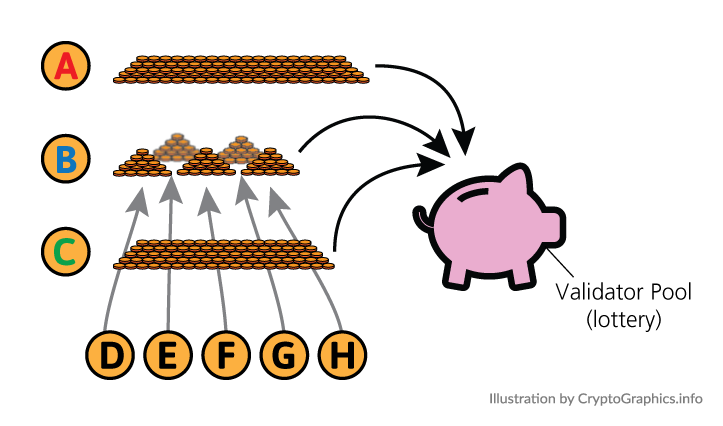
What is Leased Proof of Stake Leased Proof of Stake operates on the principle that literally everyone can win the chance to add a block to the blockchain, by using a system not much unlike a lottery which can be participated in using leased coins. In classic Proof of Stake , holders with low amounts of coins are unlikely to ever get the chance to add a block — just as small miners with low hashrate are unlikely to mine a block in bitcoin, using Proof of Work . In fact, it may be many years before a small holder is lucky enough to win. This means that many holders with low amounts of coins will never actively partake in the network, so maintaining it is left to a limited number of larger players, which inadvertently creates unwanted centralization and possible 51% attack . Leased Proof of Stake works exactly like PoS, but uses leasing to provide small holders with an incentive to take part. The low holding nodes (D, E, F, G, H) lease their balance to a staking node (B), while...

Practical Byzantine Fault Tolerance (pBFT)

Image
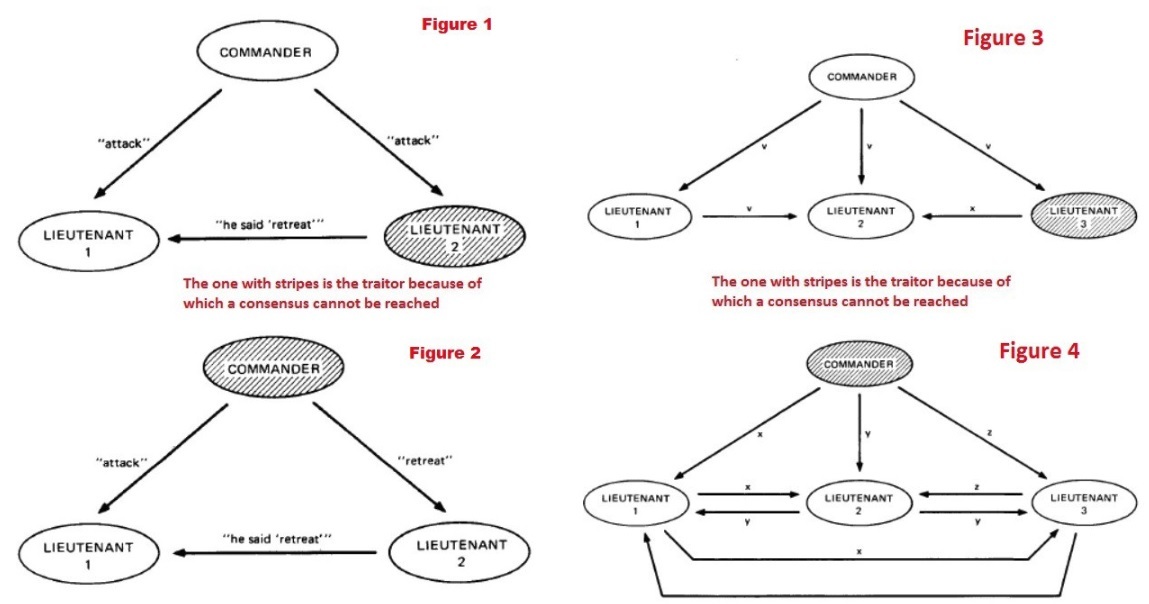
Blockchain technology represents a sum of many parts, and its consensus algorithm is certainly one of the most important pieces of this puzzle. Decentralized blockchains are envisioned as peer-to-peer systems that don’t have centralized authority points; consensus algorithms play a massive role in enabling this decentralized infrastructure to exist and work. Typical centralized systems rely on trust where certain entities act as network “leaders”, controlling the network and making important decisions about it. Everyone else trusts these leaders that they’ll stay honest and behave in a manner beneficial to the entire network. This can sometimes backfire as the network leaders can become corrupt and start acting in malicious ways. When this happens, the entire network is put at risk. By basing decentralized blockchain networks on a consensus (which is achieved between a network of widely distributed nodes that manage the blockchain), original programmers of cryptocurrencies lik...