Posts

Showing posts with the label Hashing

Real Chaos, Real Security: A Physical Approach to Blockchain Randomness

Image
Why Strong Randomness Matters Every secure cryptographic system relies on a single principle: some values must be impossible for an attacker to predict. Randomness matters because it prevents attackers from predicting secrets. Many cryptographic operations depend on values that must remain entirely unpredictable; even a slight bias shrinks the search space and makes attacks easier. A predictable random number generator functions like an unlocked door. Randomness also protects protocols from replay and forgery. Exchanging unpredictable nonces proves freshness.  If the “random” numbers behind keys, nonces, or challenges are even slightly predictable, attackers gain a dangerous advantage like to impersonate devices  (hm-hm PS3 hack), forge sessions, or inject replayed messages into secure channels. The challenge is that computers are inherently deterministic. Given the same input, they always produce the same output. That property is perfect for reproducible computation but ter...

Bitcoin Layer 2 Wars: Lightning, Liquid, and Stacks

Image
Introduction Bitcoin was designed as a secure, decentralized ledger for peer-to-peer value transfer. Its conservative approach to scalability and limited scripting language make it exceptionally secure, but also restrict throughput and programmability. To overcome these limits without changing Bitcoin’s base protocol, developers have built a growing ecosystem of Layer 2 (L2) solutions - protocols that extend Bitcoin’s functionality while inheriting its security. This first part of the Bitcoin L2 series provides a technical and economic overview of Lightning , Liquid , and Stacks  - three of the most established Bitcoin extensions. We will cover their underlying technologies, use cases, security models, protocol dependencies, tokenomics, and associated risks. 1. The Lightning Network Technology and architecture The Lightning Network is an off-chain payment network built on Bitcoin’s existing scripting capabilities. It uses hashed timelock contracts (HTLCs) to establish payme...

Babylon Protocol: When EigenLayer marries Bitcoin

Image
The Bitcoin network has long been the most secure and decentralized blockchain in existence, yet its base layer has no built-in mechanism for staking, restaking, or securing external systems. Babylon protocol changes that. It introduces a way to extend Bitcoin’s security to other Proof-of-Stake (PoS) , without bridging or wrapping BTC. Babylon is built as a sovereign Layer-1 blockchain using the Cosmos SDK, but its core purpose is to allow Bitcoin holders to stake their coins natively on Bitcoin and use that economic weight to secure other systems, called Bitcoin-Secured Networks (BSNs). This makes Babylon the Bitcoin equivalent of Ethereum’s EigenLayer restaking concept. Bitcoin Staking What Babylon Enables Babylon’s design allows BTC holders to earn yield and participate in network security while keeping their assets self-custodied on Bitcoin. It does this through three main protocol layers: Bitcoin Staking Protocol – lets users lock BTC directly on Bitcoin and use it as coll...

Bitcoin - Evolving Beyond Its “Digital Gold” Image

Image
For years, Bitcoin has often been described as static and resistant to change - a conservative, unyielding system designed only for storing value. This perception misses a crucial truth: Bitcoin is not an archaic relic, but a living, evolving protocol. Its development process is intentionally slow and deliberate, but over the past decade, it has undergone significant consensus upgrades that have made it more secure, efficient, and expressive. Far from being fixed in stone, Bitcoin continues to adapt through careful, consensus-driven innovation. Bitcoin beyond GOLD The Evolution of Bitcoin’s Consensus Upgrades Since its launch in 2009, Bitcoin has quietly transformed. The earliest version introduced the core elements we still rely on today: proof-of-work mining, the UTXO model, and a basic scripting language for defining transaction conditions. Over time, the community introduced a series of soft forks - backward-compatible upgrades that enhanced Bitcoin without splitting the network...

Exploring Zero-Knowledge Friendly Hash Functions

Image
Hash functions are crucial tools in the world of blockchain and cryptography, helping to keep data secure and intact. Recently, as zero-knowledge proofs have become more popular, there's been a need for hash functions that fit these complex systems better. This article will look at how traditional hash functions work, their role in blockchain technology, and why they're so important for security. We'll also explore why these traditional functions aren't always the best fit for zero-knowledge proofs and introduce some new hash functions—RESCUE, Poseidon, and Poseidon2—that are designed to work well in these scenarios. What is a Hash Function? A hash function is a mathematical algorithm that converts input data of any size into a fixed-size string of bytes, typically a hash, which appears random. Hash functions are fundamental in various applications, including data integrity verification, password storage, and digital signatures. They are crucial for ensuring that d...

Understanding Pedersen and Kate Commitments

Image
Cryptographic commitments play a pivotal role in ensuring the integrity and security of digital transactions and communications. Among the myriad of commitment schemes available, Pedersen and Kate commitments stand out for their unique properties and applications. This article delves into the intricacies of both, drawing insights from a previous discussion on Kate commitments Kate Polynomial Commitments . What are Pedersen Commitments? Pedersen commitments are renowned for their simplicity and elegance in cryptographic circles. At its core, a Pedersen commitment allows one to commit to a chosen value while keeping it hidden, with the ability to reveal the committed value later. The magic lies in its two-fold assurance: it's both hiding (the value cannot be guessed) and binding (the committer can't change the value once committed). The Mechanism Select Parameters : Choose a large prime number p and a generator g of a group of order q (where q is also a large prime ...

Decoding the PlayStation 3 Hack: Unraveling the ECDSA Random Generator Flaw

Image
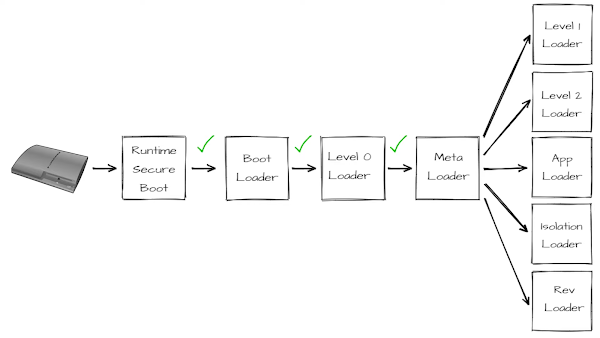
In 2006, Sony unleashed the PlayStation 3, a cutting-edge gaming console that quickly captivated the hearts of millions. However, behind its sleek design and powerful gaming capabilities lay an enticing challenge for hackers. Over the years, a myriad of attempts were made to crack the PS3's defenses, fueled by the desire to run homebrew software and pirate games. Amidst this pursuit, one group of hackers, FailOverflow, embarked on a groundbreaking mission that would send shockwaves through the cybersecurity world. In December 2010, at the Chaos Computer Congress in Germany, FailOverflow revealed a flaw that would become legendary in the annals of hacking history. Their presentation exposed a critical error in Sony's implementation of cryptographic algorithms, particularly the Elliptic Curve Digital Signature Algorithm (ECDSA) , responsible for creating signatures in the console. What they unveiled wasn't just a minor glitch—it was a seismic vulnerability. By exploiting ...