Posts

Showing posts with the label Encryption

Babylon Protocol: When EigenLayer marries Bitcoin

Image
The Bitcoin network has long been the most secure and decentralized blockchain in existence, yet its base layer has no built-in mechanism for staking, restaking, or securing external systems. Babylon protocol changes that. It introduces a way to extend Bitcoin’s security to other Proof-of-Stake (PoS) , without bridging or wrapping BTC. Babylon is built as a sovereign Layer-1 blockchain using the Cosmos SDK, but its core purpose is to allow Bitcoin holders to stake their coins natively on Bitcoin and use that economic weight to secure other systems, called Bitcoin-Secured Networks (BSNs). This makes Babylon the Bitcoin equivalent of Ethereum’s EigenLayer restaking concept. Bitcoin Staking What Babylon Enables Babylon’s design allows BTC holders to earn yield and participate in network security while keeping their assets self-custodied on Bitcoin. It does this through three main protocol layers: Bitcoin Staking Protocol – lets users lock BTC directly on Bitcoin and use it as coll...

Blockchain-Enabled Agents using zkTLS

Image
The emergence of blockchain-enabled AI agents has introduced exciting possibilities for decentralized autonomous systems. However, our previous discussions about production-ready blockchain AI agents revealed a significant limitation: while blockchain networks are designed to run on retail computers to maintain decentralization, modern AI agents often require high-end GPUs for running large language models. This fundamental tension threatens to centralize what should be a decentralized system. This article explores how Zero-Knowledge Transport Layer Security (zkTLS) can help resolve this contradiction by enabling secure, verifiable interactions with external AI services while maintaining the decentralized ethos of blockchain networks. The Challenge: Decentralization vs. Computational Requirements In traditional blockchain systems, nodes and validators operate on consumer-grade hardware, ensuring broad participation and true decentralization. However, the integration of AI capabilities,...

Understanding Hardware Wallets

Image
Introduction In the world of cryptocurrency, managing multiple accounts securely and conveniently is paramount. Hardware wallets, such as the Ledger , SafePal and others, achieve this by utilizing a single seed phrase to manage multiple accounts. This is made possible through a concept called hierarchical deterministic (HD) wallets. In this article, we will explore the mechanics of path derivation and touch on the extent of security if the connected computer or browser wallet is compromised. Path Derivation: The Core of HD Wallets Path derivation is a method used in HD wallets to generate multiple key pairs from a single seed phrase. Each account in an HD wallet is derived from a master private key using a specific derivation path. This allows for the creation of a structured tree of key pairs, enabling a single seed phrase to manage numerous accounts. How Does It Work? When you initialize your hardware wallet, a seed phrase (12, 18, or 24 words) is generated. This seed phra...

Choosing the right SNARK Backend

Image
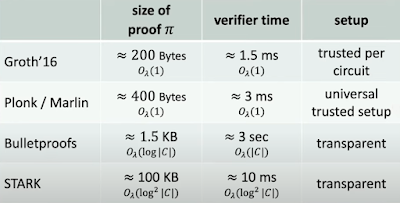
Building on our previous discussions from "[SNARKs 101](https://deeprnd.medium.com/snarks-101-40189a12eabc)", today we delve deeper into the backend systems of SNARKs, which play a pivotal role in the practical application of these technologies. Conceptually, in the backend, the verifier challenges the prover. However, this interaction is cleverly abstracted away using cryptographic methods, resulting in a static proof where the verifier never directly interacts with the prover. Here, the prover claims to know a satisfying assignment to the circuit. This part of the SNARK system is what you typically encounter in literature, encompassing names like Groth16, Marlin, PlonK, and others, each referring to different backends of the probabilistic proof system. In this piece, we'll examine various SNARK constructions and their appropriate setups, considering factors such as trusted setups versus transparent setups. As we continue our series, we will explore how choosing the r...

Kate Polynomial Commitments

Image
Introduction Kate polynomial commitments are a cryptographic primitive that allow one to commit to a polynomial in a way that is both hiding and binding. This means that the commitment does not reveal any information about the polynomial, and it is impossible to change the polynomial once the commitment has been made. In simpler terms, Kate polynomial commitments allow one to lock a polynomial into a secret box. The box is locked so that no one can see what polynomial is inside, but the box is also transparent so that anyone can verify that the polynomial inside has not been changed. How Kate Polynomial Commitments Work Kate polynomial commitments are based on a mathematical object called a bilinear pairing. A bilinear pairing is a type of mathematical function that takes two elements from one group and produces an element from another group, and have many useful properties, including the ability to be used to create cryptographic commitments. To commit to a polynomial usin...

STARK vs SNARK

Image
In the world of cryptography and blockchain technology, zero-knowledge proofs have emerged as a powerful tool for ensuring privacy and security. Among the various zero-knowledge proof systems, STARK and SNARK have gained significant attention due to their unique properties and potential applications. This article aims to provide a comprehensive comparison of these two technologies, delving into their differences, advantages, and disadvantages. We will also explore the underlying mathematical concepts and commitment schemes that make these technologies possible. Understanding STARK and SNARK STARK (Scalable Transparent ARguments of Knowledge) and SNARK (Succinct Non-interactive ARguments of Knowledge) are both cryptographic proof systems that enable a prover to convince a verifier that a certain statement is true without revealing any information about the statement itself. The primary difference between the two lies in their acronyms: STARK is scalable and transparent, while SNARK ...

Symmetric and Asymmetric Encryption

Image
What is Encryption and Cryptographic Keys? Encryption is actually an age-old practice dating back to the times of the famous Roman king Caesar, who encrypted his messages using a Caesar cipher. The practice can be viewed as a transformation of information whereby the sender uses plain text, which is then encoded into cipher text to ensure that no eavesdropper interferes with the original plain text. On receiving the encoded message, the intended receiver decrypts it to obtain the original plain text message. Once the transaction data encrypted then it can only be decrypted using the appropriate keys, its called a “Cryptographic keys“. A cryptographic key is a password which is used to encrypt and decrypt information. There are two types of cryptographic keys. They are known as symmetric key and asymmetric key cryptography: symmetric and asymmetric encryption. What is Symmetric Encryption? Symmetric Encryption also called Secret Key Cryptography, it employs the same secret key...