Posts

Showing posts with the label Cryptography

Babylon Protocol: When EigenLayer marries Bitcoin

Image
The Bitcoin network has long been the most secure and decentralized blockchain in existence, yet its base layer has no built-in mechanism for staking, restaking, or securing external systems. Babylon protocol changes that. It introduces a way to extend Bitcoin’s security to other Proof-of-Stake (PoS) , without bridging or wrapping BTC. Babylon is built as a sovereign Layer-1 blockchain using the Cosmos SDK, but its core purpose is to allow Bitcoin holders to stake their coins natively on Bitcoin and use that economic weight to secure other systems, called Bitcoin-Secured Networks (BSNs). This makes Babylon the Bitcoin equivalent of Ethereum’s EigenLayer restaking concept. Bitcoin Staking What Babylon Enables Babylon’s design allows BTC holders to earn yield and participate in network security while keeping their assets self-custodied on Bitcoin. It does this through three main protocol layers: Bitcoin Staking Protocol – lets users lock BTC directly on Bitcoin and use it as coll...

Building L1 Blockchains with EigenLayer AVS: A Guide for Substrate Developers

Image
In the ever-evolving blockchain ecosystem, scalability, validator incentives, and network security remain core challenges for Layer 1 (L1) blockchain developers. Substrate provides the perfect foundation for building customizable L1 blockchains, but integrating newer technologies like EigenLayer’s Autonomous Verifiable Service  (AVS) can help bring additional value to a project. This article will explain how Substrate developers can leverage EigenLayer's AVS for validator selection while keeping project tokens on Ethereum for liquidity. We will explore the major components of building a Substrate-based L1 blockchain with EigenLayer integration, focusing on how to choose validators, distribute rewards, and interact with Ethereum. This guide assumes you’re using Substrate Frame 2 and have a basic understanding of Substrate development. Introduction to EigenLayer AVS EigenLayer’s Active Validator Selection (AVS) system allows blockchain projects to leverage Ethereum validators thr...

Understanding Hardware Wallets

Image
Introduction In the world of cryptocurrency, managing multiple accounts securely and conveniently is paramount. Hardware wallets, such as the Ledger , SafePal and others, achieve this by utilizing a single seed phrase to manage multiple accounts. This is made possible through a concept called hierarchical deterministic (HD) wallets. In this article, we will explore the mechanics of path derivation and touch on the extent of security if the connected computer or browser wallet is compromised. Path Derivation: The Core of HD Wallets Path derivation is a method used in HD wallets to generate multiple key pairs from a single seed phrase. Each account in an HD wallet is derived from a master private key using a specific derivation path. This allows for the creation of a structured tree of key pairs, enabling a single seed phrase to manage numerous accounts. How Does It Work? When you initialize your hardware wallet, a seed phrase (12, 18, or 24 words) is generated. This seed phra...

Exploring Zero-Knowledge Friendly Hash Functions

Image
Hash functions are crucial tools in the world of blockchain and cryptography, helping to keep data secure and intact. Recently, as zero-knowledge proofs have become more popular, there's been a need for hash functions that fit these complex systems better. This article will look at how traditional hash functions work, their role in blockchain technology, and why they're so important for security. We'll also explore why these traditional functions aren't always the best fit for zero-knowledge proofs and introduce some new hash functions—RESCUE, Poseidon, and Poseidon2—that are designed to work well in these scenarios. What is a Hash Function? A hash function is a mathematical algorithm that converts input data of any size into a fixed-size string of bytes, typically a hash, which appears random. Hash functions are fundamental in various applications, including data integrity verification, password storage, and digital signatures. They are crucial for ensuring that d...

Choosing the right SNARK Backend

Image
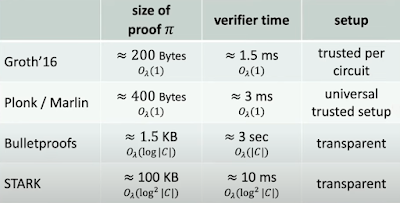
Building on our previous discussions from "[SNARKs 101](https://deeprnd.medium.com/snarks-101-40189a12eabc)", today we delve deeper into the backend systems of SNARKs, which play a pivotal role in the practical application of these technologies. Conceptually, in the backend, the verifier challenges the prover. However, this interaction is cleverly abstracted away using cryptographic methods, resulting in a static proof where the verifier never directly interacts with the prover. Here, the prover claims to know a satisfying assignment to the circuit. This part of the SNARK system is what you typically encounter in literature, encompassing names like Groth16, Marlin, PlonK, and others, each referring to different backends of the probabilistic proof system. In this piece, we'll examine various SNARK constructions and their appropriate setups, considering factors such as trusted setups versus transparent setups. As we continue our series, we will explore how choosing the r...

Zero-Knowledge Proofs in Rust and Bellman

Image
In an era where data privacy is paramount, Zero-Knowledge Proofs (ZKPs) stand out as a beacon of hope. They are cryptographic protocols enabling one party to prove to another that a statement is true, without revealing any information apart from the fact that the statement is indeed true. One such application of ZKPs is through SNARKs , a variant offering efficiency and succinctness. The Role of Zero-Knowledge Proofs in Modern Cryptography Zero-Knowledge Proofs, particularly SNARKs, are revolutionizing the way we think about privacy and security in the digital age. They allow the verification of complex operations, like the validity of a transaction or the correctness of a computational task, without revealing any underlying data. This is particularly crucial in scenarios where sensitive information needs to be validated without exposing it – a situation common in blockchain technology, secure voting systems, and, as we'll explore, even in seemingly simp...

Understanding Pedersen and Kate Commitments

Image
Cryptographic commitments play a pivotal role in ensuring the integrity and security of digital transactions and communications. Among the myriad of commitment schemes available, Pedersen and Kate commitments stand out for their unique properties and applications. This article delves into the intricacies of both, drawing insights from a previous discussion on Kate commitments Kate Polynomial Commitments . What are Pedersen Commitments? Pedersen commitments are renowned for their simplicity and elegance in cryptographic circles. At its core, a Pedersen commitment allows one to commit to a chosen value while keeping it hidden, with the ability to reveal the committed value later. The magic lies in its two-fold assurance: it's both hiding (the value cannot be guessed) and binding (the committer can't change the value once committed). The Mechanism Select Parameters : Choose a large prime number p and a generator g of a group of order q (where q is also a large prime ...

Zero-Knowledge Proofs with Circom and Noir

Image
Zero-knowledge proofs (ZKPs) are a powerful cryptographic tool that allow you to prove that something is true without revealing any additional information. ZKPs are finding a wide range of applications in blockchain, including privacy-preserving transactions, scaling solutions, and decentralized gaming. In the previous article, we've discussed about some of the fundamentals behind SNARKs and STARKs , so make sure to read those if you want more details behind the tech. ZKP Languages One of the most important components of a ZKP is the circuit. A circuit is a mathematical representation of the computation that is being performed by the ZKP. Circuits are typically written in a specialized language, such as Circom or Noir. Circom is a circuit description language that is developed by the Zcash project. It is a powerful and flexible language that allows users to write circuits for a wide range of applications. However, Circom can be difficult to learn and use, and it requires a ...